
Note: This article is a general information, lifestyle feature and personal opinion. It is not professional or medical advice.
We’ve all been there.
You drag yourself out of bed after a “good” night’s sleep, but instead of feeling refreshed, you feel… attacked.
Maybe you’re sneezing uncontrollably. Maybe your eyes are puffy and red. Or worse, you look in the mirror and see mysterious red welts on your arms or legs.
Your first thought? “Did I leave the window open? Darn mosquitoes.”
But if this is happening consistently, and only when you wake up, it’s not the mosquitoes. It’s not the weather. It’s most probably your bed.
Before you panic and throw out the mattress, let’s do some detective work. Your bed is likely hosting one of two uninvited guests: Dust Mites or Bed Bugs. Knowing the difference is the key to solving the itch.
1. The Diagnosis – Who are you sleeping with?
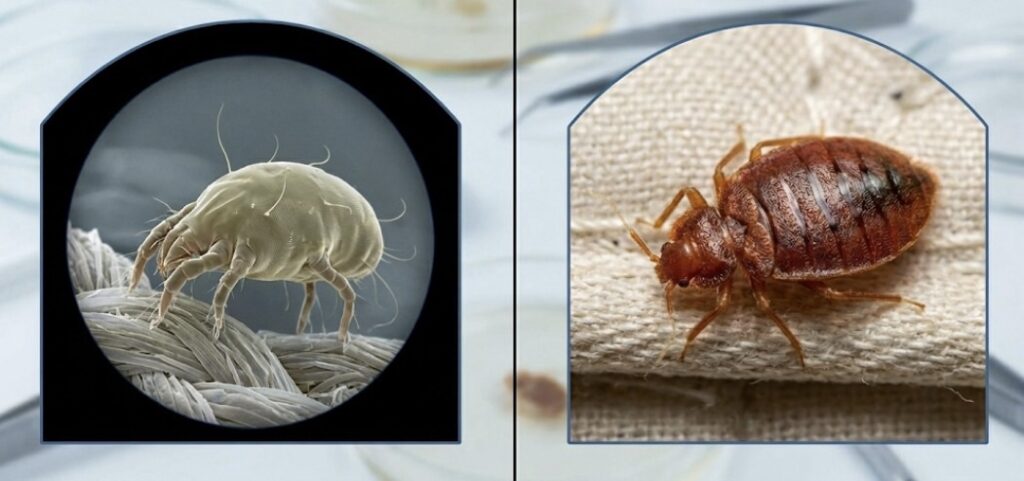
Are you sleeping with Dust Mites or Bed Bugs?
You can’t treat the problem if you don’t know what it is. Here is the quick cheat sheet to tell them apart:
Suspect A: The Dust Mite (The invisible trigger)
Dust mites are microscopic creatures that live in soft furnishings. You can’t see them, and contrary to popular belief, they do not bite you.
• The Cause of the Itch: The allergic reaction comes from their residue—specifically their waste droppings and decaying body parts (gross, we know). When you inhale this microscopic dust while sleeping, your body reacts.
• The Symptoms: Stuffy nose, watery eyes, sneezing fits, or asthma triggers. You wake up feeling “heavy” or congested.
• The Environment: They love high humidity (hello, Philippines!) and feed on dead skin cells.
Suspect B: The Bed Bug (The biter)
These are small, reddish-brown insects about the size of an apple seed. They don’t care about dust; they are looking for a meal.
• The Cause of the Itch: They actually bite.
• The Symptoms: Itchy red welts, often in a line or zigzag pattern. You might also see tiny blood spots on your sheets.
• The Environment: They are hitchhikers. They latch onto luggage or clothes from travel and infest your space.
2. The “Sponge” Effect

Your mattress acts like a giant sponge. Over time, it absorbs liters of sweat, oils, and accumulates a significant amount of dead skin cells.
You might have heard the urban legend that a mattress doubles in weight after 10 years. While that’s a bit of an exaggeration, the truth is still nasty.
Your mattress acts like a giant sponge. Over time, it absorbs liters of sweat, oils, and accumulates a significant amount of dead skin cells. This creates the perfect buffet for dust mites and bacteria to thrive deep inside the foam—places your weekly sheet change just can’t reach.
3. The DIY Battle Plan (What you can do TODAY)
Strip and Boil.
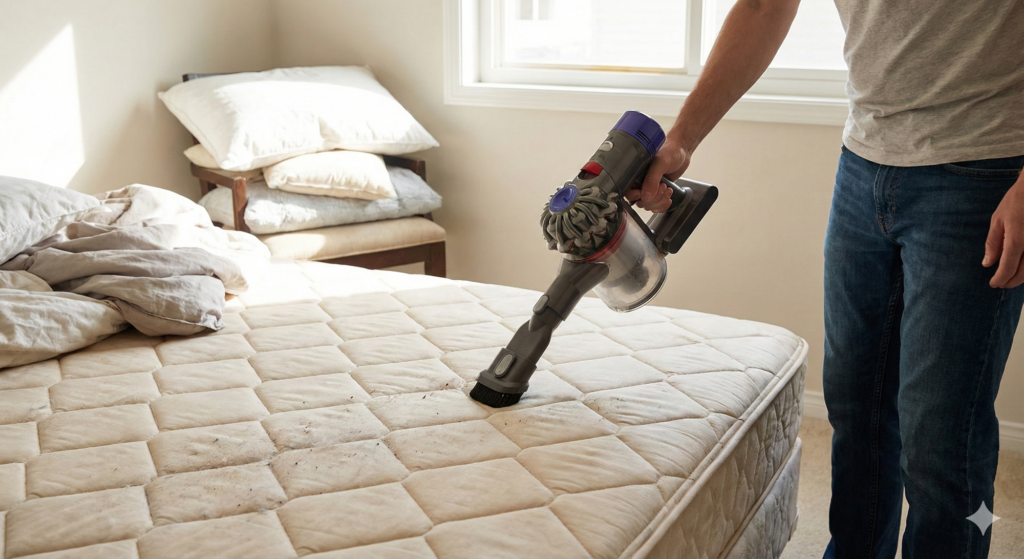
The Vacuum Assault.
The Iron Hack
If you aren’t ready to call in the professionals yet, you need to go to war with what you have. Here may be your immediate action plan.
1. Strip and Boil
Take every sheet, pillowcase, and blanket off the bed. Wash them immediately.
• The Secret: Cold water won’t cut it. You need HEAT. Wash your linens in the hottest water setting possible which is still safe for them (These bugs usually die at about 50°C). If you have a dryer, blast them on high heat for 30 minutes. This cooks the mites and bugs instantly.
2. The Vacuum Assault
Take your home vacuum and go over the entire mattress—top, bottom, and sides.
• Pro Tip: Pay special attention to the seams and piping (the edges of the mattress). Bed bugs love to hide in those tight crevices.
• Note: This removes surface bugs and dust, but unfortunately, standard vacuums rarely have the suction power to pull mite residue out from deep inside the foam.
3. The “Iron Hack”
(A Temporary & Risky Fix)
Professional steam is the gold standard for killing bugs and sanitizing surfaces because of the extreme heat. But not everyone has an industrial steamer lying around. In a pinch, some people try to use a standard clothes iron.
Does it work? Sort of. Is it risky? Yes.
Heat does kill pests, but an iron is not designed for this. It is at most surface-level (so if your mattress is thick, well, it is probably not gonna work) and may not distribute heat evenly. Proceed with extreme caution:
• Safety First: Never put a hot iron directly on your mattress! You will melt the synthetic fibers and ruin your bed immediately.
• The Method: Set the iron to the high/cotton setting. Place a thick, damp towel over the area you want to treat. Hover the iron or press lightly over the towel and pump the steam button. Move slowly along the seams.
• The Limitation: This is a surface-level fix only. The heat from an iron rarely penetrates deep enough into the foam to kill the colony living inside. It’s a temporary band-aid, not a cure.
4. The Professional Reset

Your bedroom should be your sanctuary, not a source of stress. If you’re tired of playing doctor every morning, it might be time to call in the pros for a reset.
If you’ve washed the linens, vacuumed the seams, and tried the DIY hacks but the sneezing (or biting) continues, the problem is likely too deep for household tools.
Standard vacuums remove surface dust, but they lack the power to extract the “residue” trapped deep in the high-density foam. This is where professional extraction cleaning comes in. It uses water and suction to physically pull the filth out of the core of the mattress.
Pro Tip: Mattress or Foam Deep Cleaning (Shampooing, Suction) can cost and is usually an add-on to a Deep Cleaning. If you are not ready for that yet but are booking a professional cleaner anyway, ask about their steaming process. There are cleaning services that actually offer Steam Sanitation as a free add-on when you book a deep clean (wink, wink). It’s the best way to ensure that any remaining bacteria or surface mites are neutralized without the risk of burning your bed with a clothes iron.
Good luck! And hopefully, goodbye allergies or bites soon!
Disclaimer: The information provided in this blog post is for general educational and lifestyle purposes only. It is not intended to be a substitute for professional medical advice, diagnosis, or treatment.
If you are experiencing severe allergic reactions, unexplained bites, skin infections, or respiratory issues, please consult with a qualified dermatologist or physician immediately. A blog post cannot diagnose the source of your symptoms.
Every home and infestation is unique. While deep cleaning is effective for hygiene and mite management, severe pest infestations (especially Bed Bugs) often require the services of specialized professionals. A professional on-site assessment is recommended to determine the root cause of the issue.
Any DIY methods mentioned (such as using an iron) are performed at your own risk. We are not responsible for any damage to property (scorched mattresses, fabrics) or personal injury resulting from attempting these home remedies. Always check your mattress manufacturer’s care label before applying heat or moisture.